Yi Zhang's Group @ NJU

The transition metal dichalcogenides MX2 (M = W, Mo; X = S, Se Te) monolayer with the 1T’ structural phase is an ideal two-dimensional (2D) topological insulator. However, the 1T’-MX2 with a large topological band gap (MoS2, MoSe2, WS2, WSe2) are always in metastable phases. Therefore, they are usually synthesized as the stable 2H phase in monolayer in experiments. The synthesis of a stable MX2 monolayer in stable 1T’ phase is very challenging, limiting its promotion in fundamental researches and applications. For this challenge, we first achieved the growth of WSe2 monolayer film with mixed 1T’/2H phases using MBE, and systematically investigated its phase transition with annealing. We found that the stability of 1T’ structural phase relates highly to the interfacial interaction. This work was published on Scientific Reports 9, 2685 (2019)。
Inspired by this research, we searched and found that the SrTiO3(100) substrate could provide an enhanced interfacial interaction. The interfacial distance between the grown WSe2 monolayer and SrTiO3 substrate is much smaller than that grown on BLG substrate. Meanwhile, our calculations demonstrated that when the interfacial distance is smaller than a critical value, the 1T’ phase will become more thermodynamically stable than the 2H phase. In experiments, we verified the grown WSe2 monolayer film is indeed in 1T’ single-phase, no 2H phase was formed (Fig. 1a-d). Second, we can further weaken the interfacial interaction by increasing the substrate temperature during the growth, then we can obtain the 2H single-phase 2H- and 1T’/2H mixed phase WSe2 monolayers. Last, we found that besides of the phase control, the interfacial interaction can also induce the interfacial strain, which will profoundly affect the topological band structural of the grown 1T’-WSe2 (Fig. 1e-g). This work was collaborated with the Prof. Junwei Liu’s group (HKUST), and was published on Advanced Materials 33, 200930 (2021)。
This strategy can be further applied in the growth of other 1T’-MX2. Recently, we have also realized the growth of single-phase 1T’-WS2 monolayer on SrTiO3. This 1T’-WS2 presents a much stronger interfacial interaction, inducing a flat-band feature near the top of valence band. Besides, the interfacial interaction also induces an abnormally larger band gap (0.65 eV) than the theoretical expectance, exhibiting great application potentials. This work was published onApplied Physics Letters 123, 123104 (2023)。
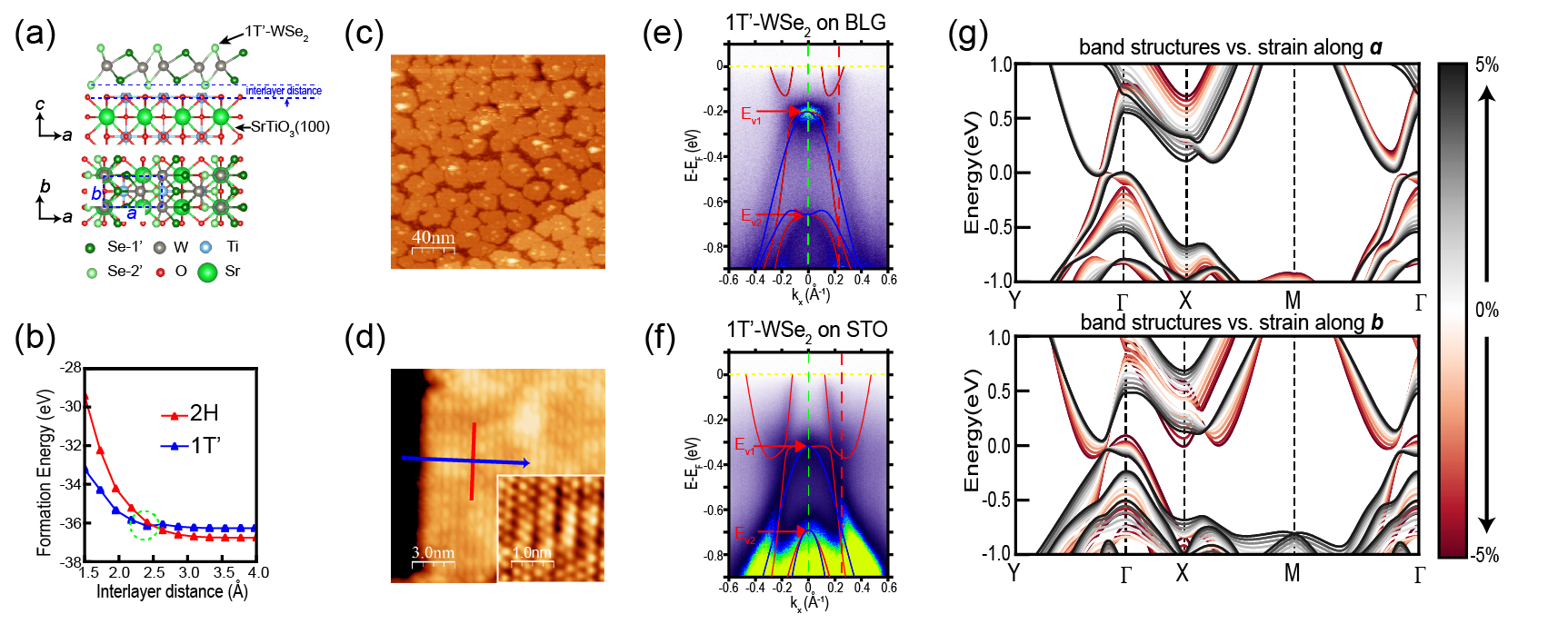 Fig. 1. MBE growth and interfacial control of single-phase 1T'-WSe2. (a)Schematic of 1T'-WSe2 and SrTiO3(100) lattice structures. (b)Forming energy of different phases depending on the interface distance. (c)&(d)STM images of the 1T'-WSe2 monolayer grown on SrTiO3(100) substrate. (e)&(f)ARPES spectra of the 1T'-WSe2 monolayers grown on BLG and SrTiO3 substrates, respectively. (g)Theoretical calculation results on the fundamental band gap depending on the interfacial strain.
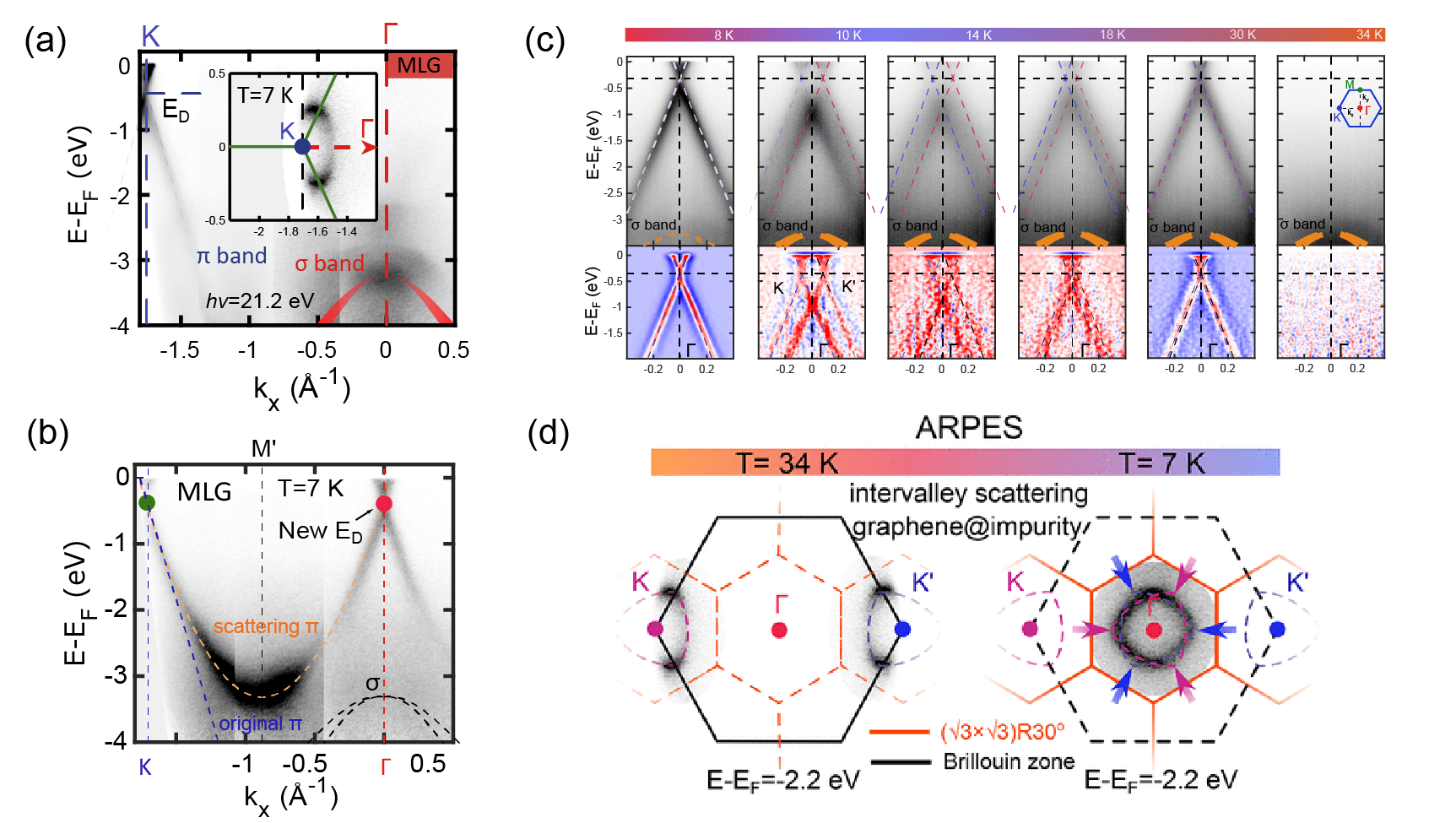
The electron scattering in 2D materials can induce many novel quantum phenomena, such as Floquet oscillation, surface wave, standing wave etc. Meanwhile, the scattering induced by the impurities and defects play important roles in the transport properties. In theory, the disordered impurities can drive an ordered hexagonal superlattice state via the correlation among electrons. However, this ordered superlattice state has not been directly observed in experiments. Here, by using ARPES, we directly observed the elastic intervalley scattering and ordered quantum interference phenomenon induced by the disordered impurities adsorbed on the single-layer and bilayer graphene grown on SiC(0001). This scattering and interference and fold the nonequivalent Dirac cones at K/K’ points into the Brillouin zone center, forming a new folded Dirac cone without chirality (Fig. 2).
Using potassium doping, we found that the surface potassium atoms can not only induce the elastic intervalley scattering and folded Dirac cone, but also can bring heavy electron doping in graphene. We found that when the doping density is high enough, it can form profound plasmon, resulting the renormalization of the Dirac cone. This renormalized plasmon band could destroy the intervalley scattering vectors, suppressing the forming of folded Dirac cone. Besides, we also studied the elastic scattering in gadolinium-intercalated graphene. we found that the gadolinium-intercalated graphene can absorb nitrogen atoms below 30 K, inducing the folded Dirac cone.
These results demonstrate that the electron scattering and ordered interference induced by the disordered impurities can effectively manipulating the Dirac band in graphene. This research is of great significance for understanding the competition and coexist relationship between different quantum stats in graphene. These works were published onNano Letters 21, 8285-8265 (2021), The Journal of Physical Chemistry Letters 13, 9396-9403 (2022), and The Journal of Physical Chemistry Letter 14, 7149-7156 (2023).
Among the 2D ferromagnetic materials, layered VSe2 has attracted great research interests due to its multiple CDW orders and ferromagnetism. The epitaxial VSe2 exhibits complex multiple CDW orders with () and () reconstructions. However, the origination and relationship between the CDW orders is still illusive. Besides, it is still under controversial that whether the monolayer 1T-VSe2 is ferromagnetic. Till now, experiment research and evidences on the origination of ferromagnetism in 1T-VSe2 are still lacking. Meanwhile, it is also challenging that how to effectively manipulating the ferromagnetism of 1T-VSe2.
In order to address these issues, we first investigated the multiple CDW orders in 1T-VSe2 depending on varied temperature by combining STM/STS and ARPES. we found a hidden incommensurate stripe-like (2×1) CDW order besides the () CDW phase at low-temperature of 4 K in the epitaxial monolayer 1T-VSe2 film. The interaction between them induces the short-range () and () reconstructions in real space. For the CDW transitions, we observed a two-step transition of an anisotropic CDW gap structure that consists of two parts Δ1 and Δ2. The gap part Δ1 that closes around 150 K is accompanied with the vanish of the () CDW phase. While another momentum-dependent gap part Δ2 can survive up to 340 K, and is suggested to the result of the incommensurate (2×1) CDW phase. This two-step transition with anisotropic gap opening and the resulted evolution in ARPES spectra are corroborated by our theoretical calculation based on a phenomenological form for the self-energy containing a two-gap structure Δ1+Δ2, which suggests different forming mechanisms between the () and the incommensurate (2×1) CDW phases. Our findings provide significant information and deep understandings on the CDW phases in monolayer 1T-VSe2 film as a two-dimensional (2D) material. This work was published on Chinese Physics B, 31(10), 107301 (2022)。
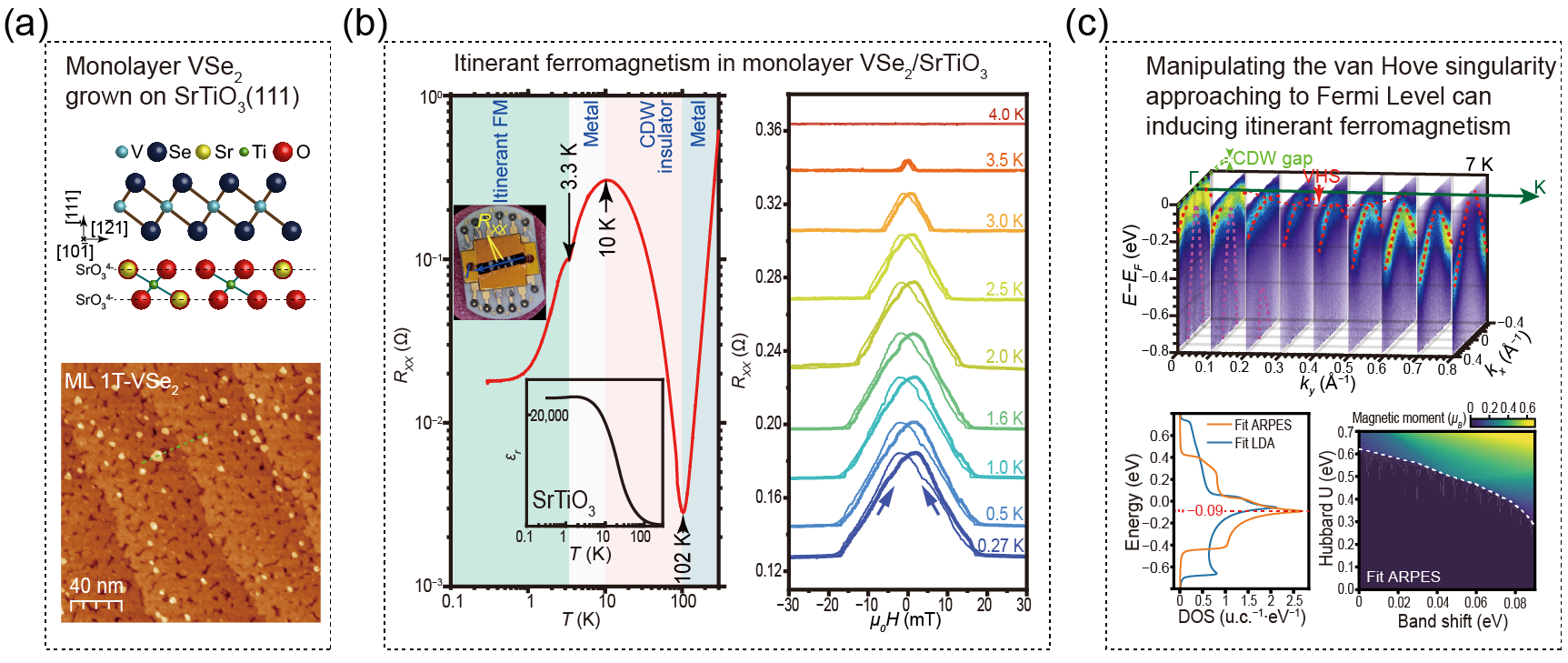
The itinerant ferromagnetism can be induced by a van Hove singularity (VHS) with divergent density of states at Fermi level. Utilizing the giant magnified dielectric constant εr of SrTiO3(111) substrate with cooling, here we successfully manipulated the VHS in the epitaxial monolayer (ML) 1T-VSe2 film (Fig. 3a) approaching to Fermi level via the large interfacial charge transfer, and thus induced a two-dimensional (2D) itinerant ferromagnetic state below 3.3 K (Fig. 3b). Combining the direct characterization of the VHS structure via angle-resolved photoemission spectroscopy (ARPES), together with the theoretical analysis, we ascribe the manipulation of VHS to the physical origin of the itinerant ferromagnetic state in ML 1T-VSe2(Fig. 3c). Therefore, we further demonstrated that the ferromagnetic state in this 2D system can be controlled through manipulating the VHS by engineering the film thickness or replacing the substrate. Our findings clearly evidence that the VHS can serve as an effective manipulating degree of freedom for the itinerant ferromagnetic state, expanding the application potentials of 2D magnets for the next-generation information technology. This work was published on Science Bulletin, 68(10), 990-997 (2023)。